Carte blanche à Wajdi Mouawad et Charlotte Farcet
Palais de la Porte Dorée — 293 avenue Daumesnil
About
Automatically translated. Read the original French text.
On the occasion of the Bicentenary of Photography, the Musée national de l’histoire de l’immigration wished to cast a gaze upon its photographic collection by inviting an outside perspective. Two perspectives in reality, themselves carriers of stories—two stories that are one, which is that of thousands—to travel through this collection and bring back reflections of a shared history. For it is around the question of sharing—what we hold in common, what these exiled lives share—that this exhibition is structured. In common, beyond appearances, differences, shores, and borders.
Each life is unique and irreducible. Yet between them lies a space of recognition, intimate, intuitive, through the experience of vulnerability, of being "shaken". The exile is one who has been shaken. The ground on which they stood was pulled out from under their feet, and with it a wealth of sensations, customs, and habits wavered, to be swept away and replaced by others. Sand by snow, for example. But likewise sounds, tastes, scents, voices, rhythms, words. Clothes, practices, places. Skin, smell, hearing, taste—spaces of contact between inside and outside—are the sites of this upheaval. Exile is a rupture of this circulation that was once so natural, so self-evident.
It is this sensory experience that interests us. And to tell it, to bring this sharing to light, the exhibition draws on stories that it brings into dialogue.
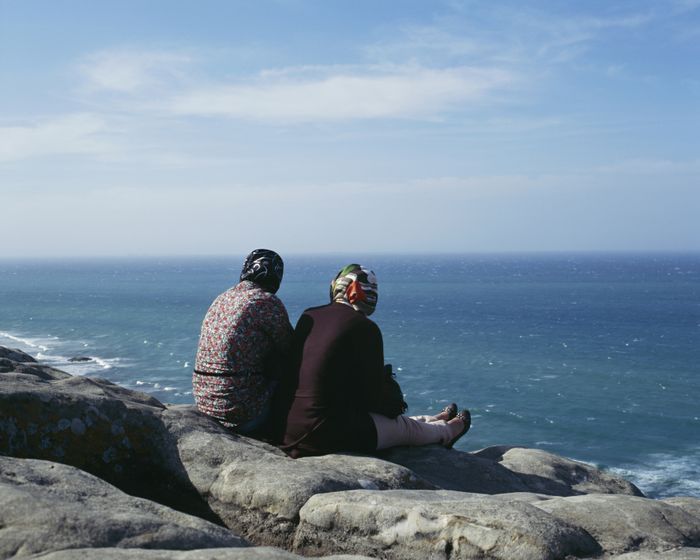
Two stories first, brought by Wajdi Mouawad and Charlotte Farcet. Those of two women, Jacqueline and Dolly, who never met—mother of the former, grandmother of the latter. Two women born on a beach, like Europa and Dido, one near Tyre in Lebanon, the other near Carthage in Tunisia; two women of radiant beauty and bodies of salt, torn from that beach and from the evidence of their lives by the blasts of a conflict that continues to this day. Two women whom history opposes and separates, and whom circumstances born of chance would reunite years later when two children experienced pure joy eating Jacqueline's cake from Dolly's plates.
The story of these two women forms the central weave of the exhibition. But how do you "exhibit" what vanished in exile? How do you narrate when what was lived was only half-transmitted, or not at all? How do you redraw the outlines and complete the lines? How do you rediscover the source of what was shared when it lies in distant lands? And how do you bear witness to what was experienced by those whom death carried away? The exhibition will therefore strive, rather than seeking precision or exhaustive accounts, to capture sensations, snippets, fragments of moments, places, and objects that defined these two lives. And these stories will converse with the innumerable, unique, and irreducible stories of other lives, offered in reflection.
The exhibition will be the space of an imaginary encounter, diffracted and multiplied through a play of echoes and reflections, a space of evocation and juxtaposition that charts an intimate path through this exile and quietly raises the question of a paradoxical happiness born from ruins. A space designed and imagined to allow visitors to walk among these lives and weave threads between them. To look up from a showcase and glimpse a face far off on a wall. A space seeking parallels, divergences, vanishing points, perspectives. A space made of a central runway of tables evoking a banquet, recounting Dolly and Jacqueline—so happy to welcome their family to their table—and on either side, across the walls, echoes of other lives gathered from the museum's photographic collections.
Through the chosen materials and its progression, the exhibition will also narrate without words this other story already preparing and taking shape: the encounter and birth of a new family. It will weave and explore imagery: the tree, roots, rhizomes, threads, weave, fabrics; the table, the banquet; order and disorder, inside and outside; the shatter. And photography will remain the raw material throughout this journey: not only that of the artists presented in mirror, but also those family photographs brought from homelands, preserved so dearly, bearing witness to a past from which our imaginations compose or recompose a history. Without forgetting the absent photographs.
Where to book
From €9Prices: full rate: 12 euros, reduced rate: 9 euros, free for under 26 years old
Getting there
DirectionsPalais de la Porte Dorée
293 avenue Daumesnil, Paris
- M8T3aPorte Dorée4 min walk
- T3aMontempoivre10 min walk
Stations: Île-de-France Mobilités
Full venue programme →Sources : OpenAgenda · details last read on 12 November 2026