Dans le plus simple appareil. 200 ans de photographies de nus
Bibliothèque nationale de France - site François Mitterrand — quai françois mauriac
About
Automatically translated. Read the original French text.
Dans le plus simple appareil
200 ans de photographies de nus
Une exposition de la Bibliothèque nationale de France
Commissariat : Flora Triebel, conservatrice en charge de la collection de photographies du XIXe siècle au département des Estampes et de la photographie, BnF
Conseil scientifique : Sylvie Aubenas, conservatrice générale, directrice du département des Estampes et de la photographie, BnF
Co-commissariat : Héloïse Conésa, cheffe du service de la photographie, conservatrice en chef chargée de la photographie contemporaine au département des Estampes et de la photographie, BnF
The nude has been, since the origins of photography, one of its most practiced, most censored, and most debated subjects. Almost all the great photographers have tried their hand at it - Félix Nadar, Man Ray, Brassaï, André Kertész, Germaine Krull, Edward Weston, Willy Ronis, Helmut Newton, Robert Mapplethorpe, Diane Arbus... No other genre reveals with such intensity what each era desires, tolerates, forbids. On the occasion of the Bicentenary of photography, the BnF offers a journey spanning two centuries through two hundred works, from the earliest daguerreotypes made in Paris to contemporary prints.
The shock of photography
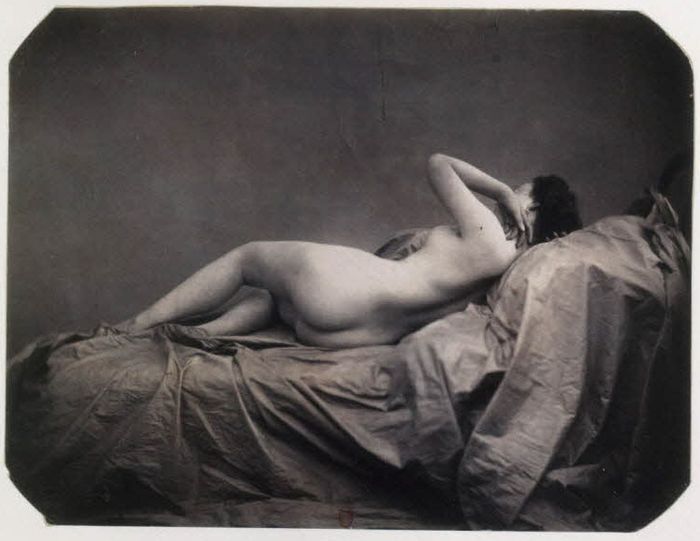
From its inception, photography inherited a long artistic tradition - and shook it up. For the photographic nude is not the painted or sculpted nude: it records a real, identifiable body, whereas painting only offers an idealized figure. Photography did not invent the scandal of the nude, but stripped away its alibi. The daguerreotypes by Auguste Belloc, Bruno Braquehais, or Louis Jules Duboscq, presented at the beginning of the exhibition route, make this rupture palpable: beneath the conventions of academic posing, the body asserts its presence, resisting any sublimation. This tension is constantly renewed - how to frame, light, pose, the canons that take hold then fade away, so many questions that each generation of photographers reopens and restages in its own way.
Sous le manteau
The first decades of photography were immediately marked by equivocal uses. Some photographers marketed clandestine images, risking prosecution for outrage against public decency. Félix Moulin or Auguste Belloc, several prints of whose work are presented in the exhibition, experienced this firsthand. A few prints from this era still bear, affixed directly to the print, restrictions labels on window display. The same images circulated as academic models for the Beaux-Arts, and were purchased for other uses, other gazes. The border has always been porous.
A few decades later, conditions had changed, though resistance had by no means disappeared. In the 1900s, the luxurious magazine Camera Work published nudes by Edward Steichen, as well as by women photographers, Alice Boughton and Annie Brigman. Nude photography books entered the legitimate publishing circuit, such as Etudes de nu by Germaine Krull in 1931; magazines circulated freely; exhibitions institutionalized the genre. In 1933, the first international salon of photographic nude organized in Paris by Daniel Masclet brought together Man Ray, Laure Albin-Guillot, František Drtikol: the nude was recognized as a full-fledged artistic subject. Taboos did not disappear, they shifted.
Corps et corpus inédits
The exhibition follows a chronological thread, but lingers at each era on several facets of the subject. One of the most decisive is that of models and their identification: Marie-Christine Roux, a figure of the Parisian bohemian scene photographed by Félix Moulin and Félix Nadar; the beautiful Antonia, whose face passed through several studios; the bustling Clara Ward; Émilienne Bouillon, photographed in autochrome by Robert Demachy; Assia, muse of the interwar period. For some of these women, dressed portraits and nude views are presented side by side, restoring an existence that the deliberate anonymity of these images had erased.
The route gives pride of place to the photographers who established the modern canon of the nude, Brassaï, Man Ray, Edward Weston, André Kertész, and to those who worked in their wake while shifting its course, Bill Brandt, Ralph Gibson, or John Coplans. But it also opens up to less expected registers: fashion and advertising, which made the nude, notably through the lens of Helmut Newton, an instrument of commercial seduction; documentary and nudist images, where the desexualized body became a social subject; intimate photographs, from Henri de Toulouse-Lautrec diving naked into the Arcachon basin to Raoul Hausmann on the beach, to the secret images that Pierre Louÿs devoted to Marie de Régnier. Wide recognition is finally given to the practice of women photographers: Laure Albin-Guillot, Rogi André, Germaine Krull in the interwar period; Sarah Moon, Elizabeth Lennard, and many others in subsequent decades.
The male nude runs through the exhibition as a distinct thread. Present from the earliest daguerreotypes, it was nevertheless less subject to ambiguity than the female nude, produced in far greater numbers. It was at the end of the nineteenth century, with Wilhelm von Gloeden and Guglielmo Plüschow photographing the young men of Taormina, that an unapologetic eroticization took hold, still cloaked in references to Antiquity. With Robert Mapplethorpe, a century later, all mediation fell away: the eroticized male nude became the expression of a proud and self-representing gay culture.
Du daguerréotype à l’intelligence artificielle
Two hundred years of the nude in two hundred photographs: from the earliest daguerreotypes to images generated by artificial intelligence, retouched negatives, hand-colored prints, intimate albums, glamour magazines, calendars, postcards. The exhibition showcases the extraordinary diversity of objects that two centuries of photography have produced around the nude, and the very different audiences they addressed. The stereoscopic daguerreotype, sometimes enhanced with color, sits alongside luxurious plates from Camera Work, which themselves stand beside scraped and retouched prints, designed to erase hair here, slim a waist there.
Two centuries of nude photography means two centuries of inventing mechanisms, techniques, and processes to show and to hide, to legitimize and to subvert. Where pioneers sparked the shock of the real body, certain contemporary photographers confront bodies far removed from stereotypes of beauty, or even craft bodies that have never existed - which nonetheless inherit everything that preceded them.
Where to book
From €8Prices: Tarifs : - Plein tarif : 10€ - Tarif réduit : 8€ Conditions des tarifs réduits et de gratuité sur : https://www.bnf.fr/fr/tarifs-dacces-aux-bibliotheques-et-loffre-culturelle#bnf-offre-culturelle
Getting there
DirectionsBibliothèque nationale de France - site François Mitterrand
quai françois mauriac, Paris
- M6Quai de la Gare8 min walk
- M14RER CBibliothèque François Mitterrand Emile Durkheim8 min walk
Stations: Île-de-France Mobilités
Full venue programme →Sources : OpenAgenda · details last read on 13 November 2026