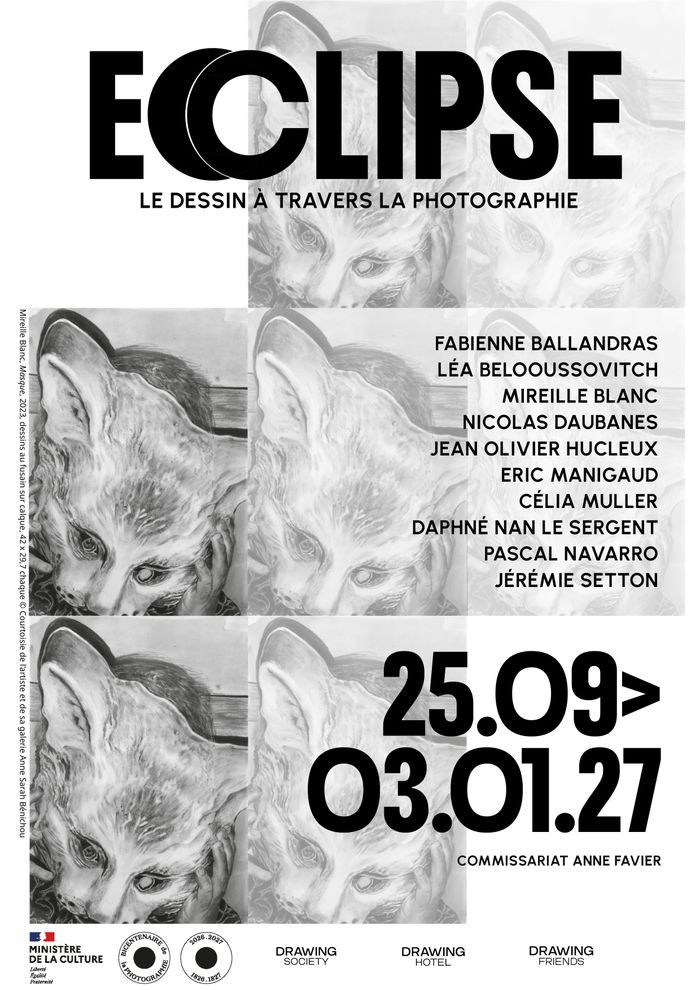
Éclipse, le dessin à travers la photographie
Drawing Lab — 17 rue de Richelieu 75001 Paris
- AccessibilityReduced mobility
About
Automatically translated. Read the original French text.
As part of the Bicentenary of Photography, the Drawing Lab, a laboratory for experimentation and diffusion of contemporary drawing, presents a collective exhibition highlighting the links between photography and drawing.
While in 1826 Nicéphore Niépce invented photographic shooting, his contemporary Henry Fox Talbot also believed he had discovered, with photography, a “loyal pencil”, capable of naturally capturing the writing of shadows and lights. He also named photograms “photogenic drawings”, sensitive prints obtained by direct contact, the beginnings of photography as a process of fixation and momentary obscuration of light.
While today photography is recognized as one of the great artistic mediums, this collective exhibition intends to show the close dialogues it maintains with contemporary drawing, in all its forms, and how the latter singularly develops and reinvents itself in the shadow of this bicentennial invention.
In an era where photography and post-photography are at the origin of the majority of images, some draftsmen maintain a disturbing proximity to these source images, up to the most faithful replica or translation. They thus create drawings of incredible photogeny, raising doubts about their graphic or photographic nature. But why “waste” so much time redrawing a snapshot? The transfer of the photographic image into drawing is above all a process of unveiling: the document becomes a genuine surface for exploration to be scrutinized, thoroughly searched, to be “transmuted”, according to Jean Olivier Hucleux. While the draftsman tends to efface himself in the operation of rendering the image, he reveals and intensifies the clues of the photographic — details, grain, texture, surface, materiality, fragility — while charging the image with a new duration and tactility. Through a historical work by Jean Olivier Hucleux and other more recent works (Daphné Nan Le Sergent, Mireille Blanc, Éric Manigaud, Célia Muller), the exhibition intends to make perceptible this “becoming graphited of the image”, to quote Jean-Christophe Bailly regarding the transition to drawing.
The photographic image can also eclipse itself through various processes of graphic transposition: blurring (Léa Belooussovitch), “blind” transcription, superposition, association or confrontation (Fabienne Ballandras). These visual shifts provoke new focusings and focal distances, perceptual blurring —up to illegibility or abstraction— and open critical points of view from photographic images, particularly media images — “shock photos”, from photojournalism, but also from photo captions. Drawing thus gives them new materialities, visibilities and temporalities.
Furthermore, by presenting complex photo-graphic devices (the incandescent photograms of Nicolas Daubanes, an interactive installation by Jérémie Setton in which the spectator doubly reveals the image, or the photosensitive works of Pascal Navarro that appear gradually), the exhibition explores through drawing the founding principles of photography: latent image, revelation, fixation, reproducibility, negative/positive reversibility, photosensitization, imprint. Through these experimental works, drawing then becomes photographic itself.
Historical piece, emblematic and experimental works, unpublished productions and reactivated installations for the Drawing Lab will thus compose a journey of works echoing each other, across three axes — “Devenir graphité”, “Mises au point” and “Image latente”. In the Éclipse exhibition, drawing thus reveals itself to the test of photography.
Curatorship: Anne Favier
All dates 2
- Fri 25 Sept→ 3 JanThis date
- Fri 25 Sept→ 3 Jan
Where to book
Getting there
DirectionsDrawing Lab
17 rue de Richelieu 75001 Paris, Paris
- M1M7Palais Royal - Musée Du Louvre3 min walk
- M7M14Pyramides4 min walk
Stations: Île-de-France Mobilités
Full venue programme →Sources : OpenAgenda · details last read on 14 November 2026