
 Workshop
Exposition monographique consacrée à l’artiste australienne GW BOT | GLYPHMAKER - La métamorphose des signes
About
Automatically translated. Read the original French text.
Born in 1954 in Quetta, Pakistan, to Australian parents, GW Bot is an Australian artist whose work explores the connections between human beings, the landscape and the inner world. A childhood spent in several countries sparked an early interest in cultures and territories. She studied art in London, Paris and Australia, graduating in 1982 from the Australian National University in Canberra. Since nineteen eighty-five, she has devoted herself fully to her artistic practice. Based in Canberra, amid surroundings that became her main source of inspiration, she adopted the wombat as her totem animal, in reference to the unity between human beings and their environment found in some Aboriginal traditions. She formed her artist's name from one of the earliest written names for the wombat in a French source: “le Grand Wam Bot”.
Foreword to the exhibition
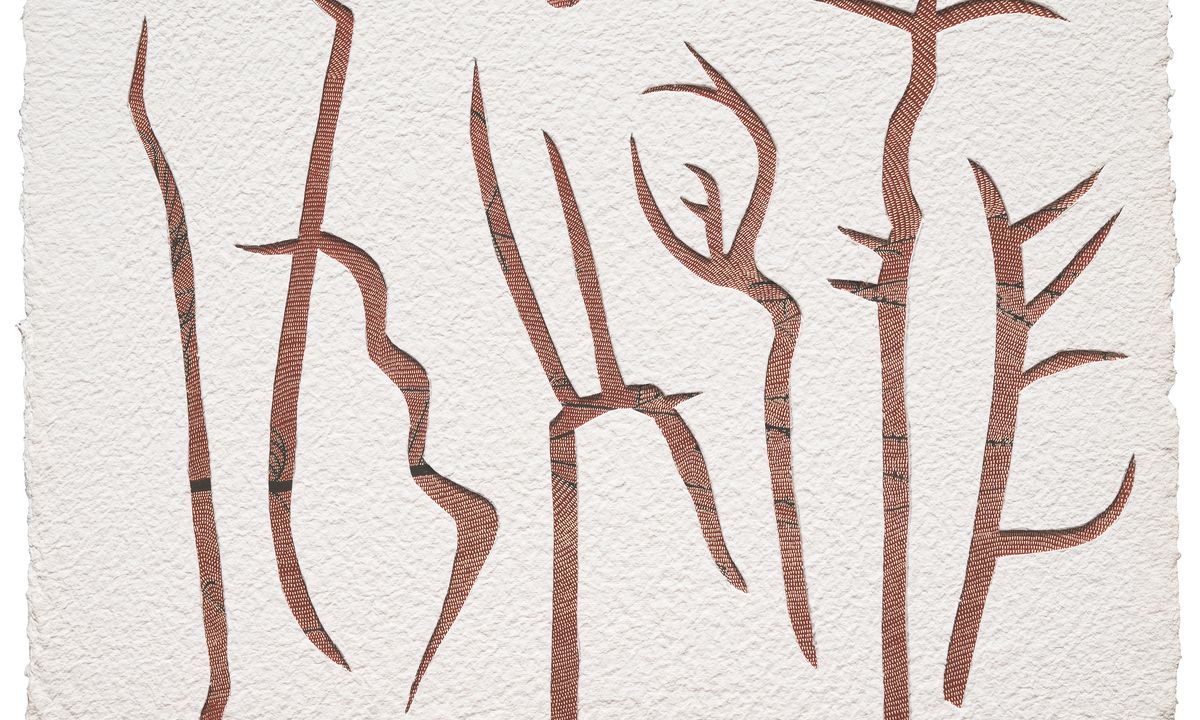
Through her work, GW Bot develops a distinctive visual language based on “glyphs”, signs she invents and transforms through contact with Australian landscapes. A glyph is a graphic sign carrying both a form and a meaning. Somewhere between plant, animal and human forms, these signs make up an open alphabet whose meaning remains deliberately mysterious.
The artist does not seek to depict nature realistically. Instead, she conveys its rhythms, forces and transformations. Forests, grasslands, cliffs, burnt land and arid landscapes become the sources of a personal form of writing.
Her world has also taken shape through many journeys in Europe and the Middle East. Byzantine art, the sculptures of Aghtamar, patterns in oriental carpets and La Dame à la licorne have fed her imagination and enriched her vocabulary of forms and symbols. Literature and poetry, particularly the work of Alexandre Pouchkine, also accompany her reflections on creation and the figure of the poet.
Gradually, her work has turned towards the theme of the garden. This becomes a space both external and internal, where nature, intimacy and spirituality meet. Drawing in particular on the tradition of the hortus conclusus and religious imagery, GW Bot makes the garden a place of contemplation and passage between the visible and the invisible. In some respects, this attention to the garden may recall Bonnard, for whom it also becomes an emotional and painterly territory.
All these influences come together in work deeply rooted in the Australian landscape and attentive to its fragility. Fire, drought, disappearance and rebirth become expressions of the cycles running through the living world.
The “black sun”, a recurring motif in her work, introduces a dimension both cosmic and symbolic. It evokes the relationships between darkness and light, disappearance and rebirth, and accompanies the idea of transformation.
Linocut, pigments, graphite, cut-outs and tapa contribute to this visual writing of impressions, layers and transparencies. The choice of paper also plays an essential role in her creative process. GW Bot sees it as a true “ground”: its texture, density and ability to receive the image directly influence the result. Each paper has its own qualities and, like soil, can accommodate certain forms and transform others.
GW Bot's work thus creates a poetic cartography in which landscape, memory, spirituality and language continually meet and transform one another.
Practical info
Last date: 23 January 2027
Full venue programme →
All dates 71
- Tuesday, 3 November 2026 · 10:00 This date
- Wednesday, 4 November 2026 · 10:00
- Thursday, 5 November 2026 · 10:00
- Friday, 6 November 2026 · 10:00
- Saturday, 7 November 2026 · 10:00
- Monday, 9 November 2026 · 10:00
- Tuesday, 10 November 2026 · 10:00
- Wednesday, 11 November 2026 · 10:00
- Thursday, 12 November 2026 · 10:00
- Friday, 13 November 2026 · 10:00
- Saturday, 14 November 2026 · 10:00
- Monday, 16 November 2026 · 10:00
- Tuesday, 17 November 2026 · 10:00
- Wednesday, 18 November 2026 · 10:00
- Thursday, 19 November 2026 · 10:00
- Friday, 20 November 2026 · 10:00
- Saturday, 21 November 2026 · 10:00
- Monday, 23 November 2026 · 10:00
- Tuesday, 24 November 2026 · 10:00
- Wednesday, 25 November 2026 · 10:00
- Thursday, 26 November 2026 · 10:00
- Friday, 27 November 2026 · 10:00
- Saturday, 28 November 2026 · 10:00
- Monday, 30 November 2026 · 10:00
- Tuesday, 1 December 2026 · 10:00
- Wednesday, 2 December 2026 · 10:00
- Thursday, 3 December 2026 · 10:00
- Friday, 4 December 2026 · 10:00
- Saturday, 5 December 2026 · 10:00
- Monday, 7 December 2026 · 10:00
- Tuesday, 8 December 2026 · 10:00
- Wednesday, 9 December 2026 · 10:00
- Thursday, 10 December 2026 · 10:00
- Friday, 11 December 2026 · 10:00
- Saturday, 12 December 2026 · 10:00
- Monday, 14 December 2026 · 10:00
- Tuesday, 15 December 2026 · 10:00
- Wednesday, 16 December 2026 · 10:00
- Thursday, 17 December 2026 · 10:00
- Friday, 18 December 2026 · 10:00
- Saturday, 19 December 2026 · 10:00
- Monday, 21 December 2026 · 10:00
- Tuesday, 22 December 2026 · 10:00
- Wednesday, 23 December 2026 · 10:00
- Thursday, 24 December 2026 · 10:00
- Friday, 25 December 2026 · 10:00
- Saturday, 26 December 2026 · 10:00
- Monday, 28 December 2026 · 10:00
- Tuesday, 29 December 2026 · 10:00
- Wednesday, 30 December 2026 · 10:00
- Thursday, 31 December 2026 · 10:00
- Friday, 1 January 2027 · 10:00
- Saturday, 2 January 2027 · 10:00
- Monday, 4 January 2027 · 10:00
- Tuesday, 5 January 2027 · 10:00
- Wednesday, 6 January 2027 · 10:00
- Thursday, 7 January 2027 · 10:00
- Friday, 8 January 2027 · 10:00
- Saturday, 9 January 2027 · 10:00
- Monday, 11 January 2027 · 10:00
- Tuesday, 12 January 2027 · 10:00
- Wednesday, 13 January 2027 · 10:00
- Thursday, 14 January 2027 · 10:00
- Friday, 15 January 2027 · 10:00
- Saturday, 16 January 2027 · 10:00
- Monday, 18 January 2027 · 10:00
- Tuesday, 19 January 2027 · 10:00
- Wednesday, 20 January 2027 · 10:00
- Thursday, 21 January 2027 · 10:00
- Friday, 22 January 2027 · 10:00
- Saturday, 23 January 2027 · 10:00