
 Exhibition
Exposition : Take Off
About
Automatically translated. Read the original French text. The source text has changed; this translation is awaiting an update.
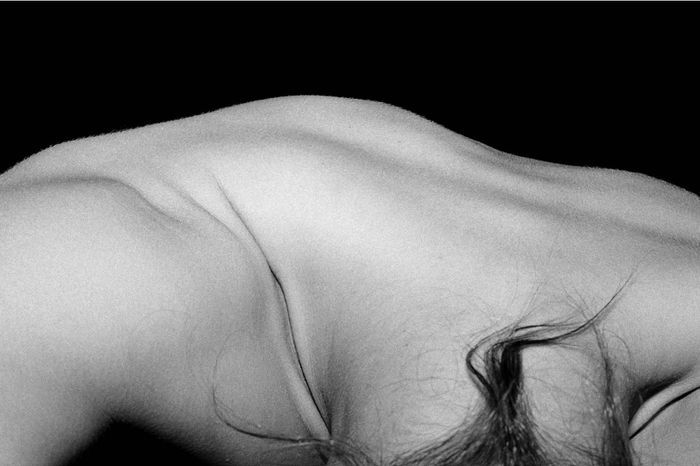
From the very first photographic prints, nearly 200 years ago, photography has always chosen the body as its subject: to capture the memory of a person, for self-promotion, to explore how it functions (Edward Muybridge), or even in staged protest scenes such as the fake death by drowning in Hippolyte Bayard's self-portrait (1840), disappointed at not having been recognized as the inventor of photography by the Académie des Sciences. The representation of the body in photography speaks volumes about our society and the way it considers not only this outer shell but also the human being behind it. Intrinsically linked to technology, photography also echoes technological advances: digitization, retouching software, 3D printing, artificial intelligence… In what ways do new technologies alter our perception of the body and the very body of photography?
It was in Paris between 1969 and 1984 that the iconic Eva Klasson developed some of her most emblematic series, including Le Troisième Angle (1976), which was exhibited at the Centre Pompidou the following year, Ombilic (1977), shown at the Musée d'Art Moderne the same year, and Parasites (1978), presented at the Swedish Cultural Center, which has since become the Institut suédois. Several of her works are now held in Swedish as well as French collections (MAM, MEP…) and her influence on an entire generation of Swedish photographers was substantial. Klasson is currently the subject of renewed interest in Sweden, notably through an exhibition that, after Borås Konstmuseum, is currently on view at Mjellby Konstmuseum, curated by art historian Lotta Granqvist, who recently published her doctoral thesis on the artist. Stemming from this singular body of work, the exhibition will be enriched by works from other photographers exploring themes close to those developed by Klasson: the body, its representation, the act of photographing oneself. The exhibition will thus provide an opportunity to question the representation of the body, both yesterday and today, as well as the evolution of photography. It will be accompanied by an associated program consisting of talks, tours, performances, concerts, etc., extending and enriching these reflections.
The title "Take Off" is inspired by another Swedish artist, herself a pioneer in video art. In 1977, Gunvor Nelson made a short film that shows, with great humor, a space striptease during which the performer goes so far as to strip away parts of her very body once fully naked.
With:
Ikram Abdulkadir, Diana Agunbiade-Kolawole, Lotta Antonsson, Lucile Boiron, Arvida Byström, Dev Dhunsi, JH Engström, Arno Rafael Minkkinen, Gunvor Nelson, Frida Orupabo, SMITH, Li Yi-Fan.
Curators: Marion Alluchon, Sara Arrhenius, and Anna Danielsson.
Scientific committee: Dragana Vujanovic-Östlihn, chief curator at Hasselblad Foundation, and Lotta Granqvist, PhD in art history.
The exhibition has received the Bicentenary of Photography label.
Practical info
Full venue programme →