
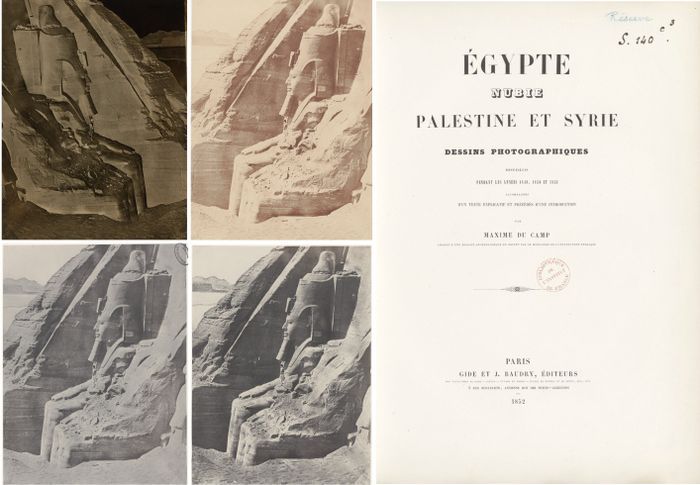
La photographie à la conquête du livre
Institut de France — 23 quai de Conti, 75006 Paris, France
About
Automatically translated. Read the original French text.
The exhibition will address one of the decisive challenges that stimulated men of letters, scientists, and artists in the wake of the invention of photography: How to make printing and photography compatible? How to use photography to illustrate books which, since Gutenberg's invention, had incorporated images previously drawn and painted, engraved on wood or copper, and later lithographed? How to overcome the initial constraint of photography (the daguerreotype is a "single-use" product) and convert it to the print economy, based on reproducibility, multiplicity, and instant text/image integration?
From the early 1840s, various technical solutions were explored and implemented, often combined, with immediate evaluations of their effectiveness, cost, stability, and documentary and/or aesthetic qualities. The contributors to this feverish history were photographers (young Nadar, the Bisson brothers…), opticians (Noël Lerebours…), publishers (Baillière, Didot…), lithographers (Lemercier…), painters (Achille Deveria…), chemists (Blanquart-Évrard, Niepce de Saint-Victor…), engineers (Eugène de Gayffier), but also archaeologists (Lottin de Laval, Charnay, Prisse d’Avennes…), astronomers (Amédée Guillemin), physicians (Duchenne…), botanists (Emile Levier…), and zoologists (Louis Rousseau), who foresaw the benefits these investigations held for their fields.
This research led to books that were at times luxurious and monumental – as public authorities, especially from the Second Empire onward, deemed it essential to support them –, at times unfinished, and at times technically mysterious. Some of these early incunabula of photography were the result of short-lived inventions, quickly abandoned due to cost or technical complexity, but most reflect a movement that, initiated in 1844 by Noël Lerebours's Excursions daguerriennes (the very year Fox Talbot's The Pencil of Nature appeared), extended into the 1880s with not only the spread of instantaneous photography (silver gelatin-bromide negatives, preparable in advance, industrializable, and with fast exposure times, replaced the collodion process), but above all the development of halftone screening, allowing photographs to be printed in relief alongside text. This culmination marked the conversion of photography to typography.
The exhibition will draw upon the exceptional collection of photography-illustrated books preserved by the Bibliothèque Mazarine and the library of the Institut de France, supplemented where necessary by loans from outside institutions (archives of the Académie des sciences, Académie des beaux-arts, Bibliothèque Sainte-Geneviève). Centered on French production, it will bring together 50 pieces (more if we decide to extend the chronological limit beyond 1884, into the early XXth century).
The technical challenges of converting, transposing, and adapting photographic images to the publishing world, with or without the intermediary of engraving, will serve as a common thread: mounting collated photographic prints, transposing photographic images onto steel plates subsequently etched with aquatint, photolithography, collotype printing, heliographic damascening, Woodburytype… until the triumph of halftone photoengraving, which prevailed in the 1880s and temporarily sealed the conversion of photo to typo… before the emergence of offset printing in the following century reversed this dynamic.
The exhibition will also highlight four other aspects:
- how the photography-illustrated book, by serving artists' desires (Promenades poétiques et daguerriennes by Louis-Auguste Martin in 1850; first photographic facsimiles of prints with Charles Blanc and the Bisson brothers, Œuvre de Rembrandt reproduit par la photographie, 1853-1858; Le Tour de Marne, published in 1865 by Émile de La Bédollière and Ildefonse Rousset…), helped legitimize photography as art, pushing back against Baudelaire's famous stance at the 1859 Salon.
- how books integrated "photographic documents" into scholarly or educational formats, particularly in archaeology, astronomy, life sciences, and medicine (Alfred Donné, Cours de microscopie, 1844-1845 [first publication of photomicrographic reproductions]; Album de photographie pathologique by Dr Duchenne in 1862…).
- the adaptation of some of these technical innovations to the periodical press. Attention will be drawn to the fact that as early as its founding year, the weekly L’Illustration (1843) incorporated an image produced with the new process (a wood engraving based on a daguerreotype).
- how these technical efforts and experiments engaged society and public authorities (cf. the competition founded by the Duke of Luynes in 1856, set to award any inventor who within three years found a way to reproduce photographic images directly through relief letterpress or flat lithographic printing).
Where to book
Getting there
DirectionsInstitut de France
23 quai de Conti, 75006 Paris, France, Paris
- M7Pont Neuf7 min walk
- M4Saint-Germain-des-Prés8 min walk
Stations: Île-de-France Mobilités
Full venue programme →Sources : OpenAgenda · details last read on 12 November 2026
Similar events
 Exhibition
 Exhibition
 Exhibition
 Exhibition