 Show
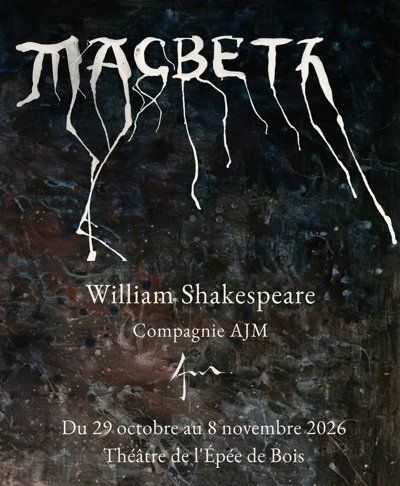
Macbeth
About
Automatically translated. Read the original French text.
“Present fears are less than horrible imaginings.” What Shakespeare says in a radical way is that what is not, what is made of the very stuff of our dreams, visions, and desires—that alone is what exists and forms the secret fabric of our lives.
This quotation operates a fundamental reversal: Macbeth ceases to be a play about an assassin king and becomes the portrait of a man consumed by the foreboding of his actions.
As A. C. Bradley emphasizes, Macbeth possesses a "poet's imagination": it is what transforms ambition into hallucinated visions, making the floating dagger or Banquo's ghost more real than the throne itself...
This reading is rooted in recent studies on pathological imagination during the Renaissance. Suparna Roychoudhury shows that the play questions "the fine line between hallucinatory fantasy and ordinary subjectivity" and raises a crucial question: to what extent do our mental images belong to us?
It also makes the wager that the secret fabric of Macbeth (his visions, his anticipated fears) is the only real character in the tragedy. Reality (the court, the battles) is merely its blurred backdrop. By giving body to what is not, Shakespeare shows that imagination does not prepare for action: it is action, and it consumes. Birnam Wood does not march: it surges from Macbeth's terrified gaze, because that is where, in his eye, the only fatality that matters is woven...
Jérôme Méla
Historical context: witchcraft, politics, and royal patronage.
This plunge into the imagination takes on special significance in light of the play's sources and context. Shakespeare draws from Holinshed's Chronicles (1587), but takes major liberties. He transforms Banquo—an accomplice to the murder in the chronicle—into an upright figure, a direct homage to King James I, a presumed descendant of Banquo.
This choice is all the more significant given that the king was a fervent believer in witchcraft. In 1597, he published his Daemonologie, a treatise in which he asserted that witchcraft was "high treason against God" and endorsed witch-hunting. His conviction was rooted in personal trauma: in 1589, he attributed a violent sea storm to a witches' conspiracy, triggering the North Berwick witch trials (1590-1592). James I believed he was the target of a satanic plot and attended the torture of suspected witches.
By including the witches in Macbeth, Shakespeare thus paid direct homage to the royal treatise—while taking a considerable risk: presenting a Scottish regicide to a newly crowned Scottish king, in a climate still burning from the Gunpowder Plot (1605). Yet the wager was a success: as early as 1603, James had made Shakespeare's troupe the "King's Men", and Macbeth solidified this royal patronage.
Practical info
Last date: 8 November 2026
Full venue programme →
All dates 5
- Thursday, 5 November 2026 · 21:00 This date
- Friday, 6 November 2026 · 21:00
- Saturday, 7 November 2026 · 16:30
- Saturday, 7 November 2026 · 21:00
- Sunday, 8 November 2026 · 16:30