
 Show
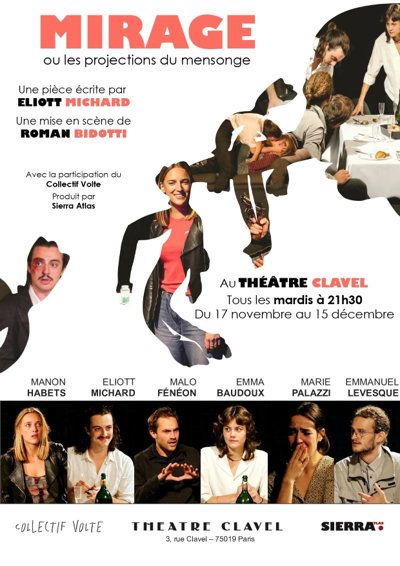
Mirage
About
Automatically translated. Read the original French text.
"I love you."
A short sentence that when really said, really thought, always has a profound impact. Once pronounced something strong is expressed, an emotion that provides relief, well-being. When this feeling of passional fever is reciprocal, nothing else matters: only the desire that this feeling endures. We must at all costs preserve the relationship, it appears as the only reason to live. This is where lying comes into play. It can be light, protective, so as not to hurt, by mistake - or else intentional, considered a necessary evil - but it always intervenes in order to keep its place with the other.
What is the limit between desire and unhealthy obsession?
Is a sweet lie better than a cruel truth?
We are taught from an early age that truth will always prevail over lies. Yet it plagues our lives every day and at any age.
How many parents lie to their children every year to make believe the Père Noël, the Easter Bunny or the little mouse?
How many people go, when asked how they behave, out of politeness, to lie and answer "very well and you?" so as not to engage in debate, not to be taken pity?
Everyone lies, out of ease or fear of shock but the harder the lie is, the harder it is to reveal it without destroying your surroundings. A secret first thought for the common good, will gradually turn into a selfish obsession.
In an apparently perfect social and family context, six characters (all wearing a more or less heavy lie) collide with the truth while trying to keep their happiness.
Practical info
Last date: 15 December 2026
Full venue programme →
All dates 10
- Tuesday, 17 November 2026 · 20:30 This date
- Tuesday, 17 November 2026 · 21:30
- Tuesday, 24 November 2026 · 20:30
- Tuesday, 24 November 2026 · 21:30
- Tuesday, 1 December 2026 · 20:30
- Tuesday, 1 December 2026 · 21:30
- Tuesday, 8 December 2026 · 20:30
- Tuesday, 8 December 2026 · 21:30
- Tuesday, 15 December 2026 · 20:30
- Tuesday, 15 December 2026 · 21:30