 Exhibition
Nadar : inventer Paris, des profondeurs au ciel
About
Automatically translated. Read the original French text.
Through temporary displays, Les Catacombes de Paris invite visitors to discover different themes, periods, or key events through artistic, historical, or technical perspectives, thus enriching the visitor experience.
New Perspectives
As part of the Bicentenary of Photography, this first display pays tribute to the pioneering role of Félix Tournachon, known as Nadar (1820-1910). Between 1858 and 1868, taking Paris as the prime ground for his numerous underground and aerial experiments, Nadar profoundly revolutionized the use of photography by overcoming immense technical challenges.
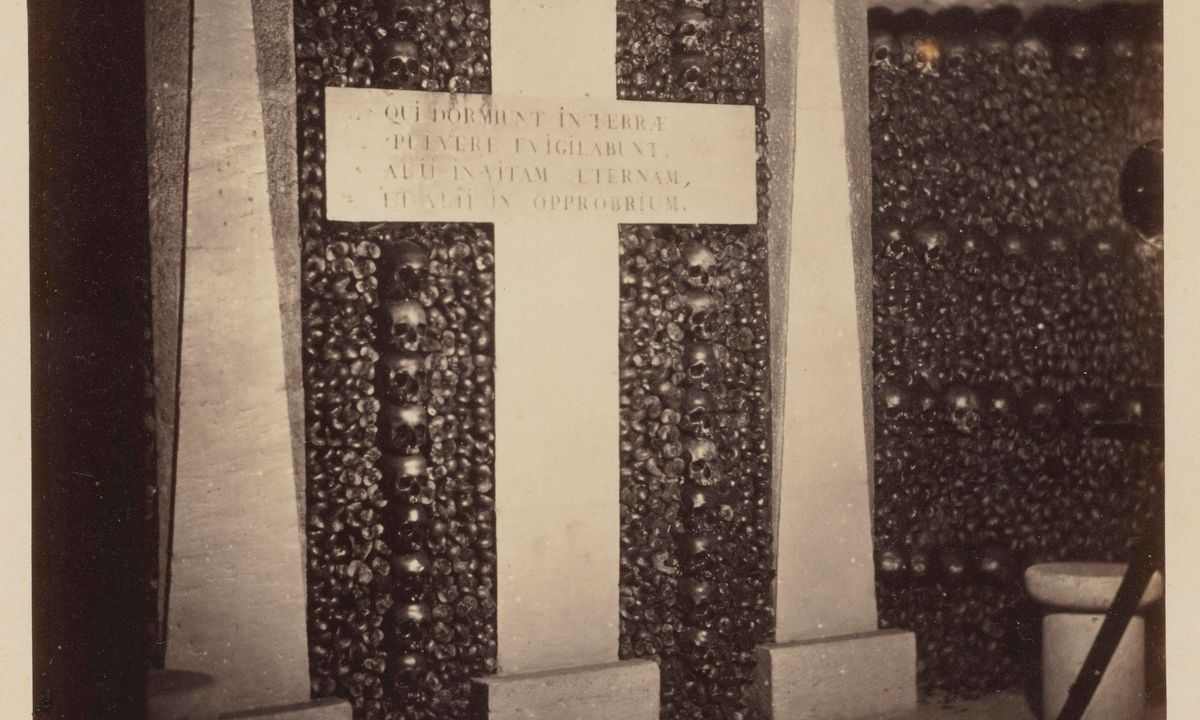
The photographs he took in the Catacombes, around twenty of which were acquired by Paris Musées in 20231, constitute an exceptional testimony. The first underground images taken using electric light, a process invented by Nadar, they also represent the earliest known images of the site.
As an introduction to the visit to the Catacombes site, the display presents a collection of about fifteen reproductions of these photographs taken by the artist in the ossuary in 1862 and then in the Paris sewers in 1865, juxtaposed with the first aerial views of Paris captured in 1868 from a balloon.
Due to the extreme fragility of the original prints and documents, the exhibition presents only reproductions. Complemented by archives (patent reproductions, advertising posters, drawings, and caricatures), these images bear witness to Nadar's major role in shaping the imaginary of the City of Light.
The Catacombes Revealed
First a writer, then a draftsman and caricaturist, Nadar went down in history as a great portrait photographer. Gifted with a curious nature, he took an interest in all scientific and technical advances of his time. He filed several patents and multiplied experiments.
In 1861, Nadar patented electric light photography. Ernest Lamé-Fleury, the inspector of quarries in charge of the Catacombes, then had the idea to invite him to experiment with his invention in the depths of Paris. Nadar accepted the technical challenge in 1862 and spent three months producing dozens of images twenty meters underground under unprecedented conditions. The timing was ideal: around 1860, major bone transfers took place in the ossuary due to Haussmann's works remodeling Paris. Nadar documented this work by photographing the new bone walls erected by quarry workers.
This was an important moment in the history of the Catacombes: one where the fantasy image of the site, spread by draftsmen and engravers who had sometimes never set foot there, gave way to the faithful and indisputable rendering of photographs. The presented images reveal, often at the edge of the frames, the complex equipment (cables, tripods, lamps, chemical bottles) and recall the physical challenges such an undertaking involved.
He replicated this setup in the Paris sewers in 1865, offering a novel perspective on the city: that of its entrails and modern infrastructure.
The Conquest of the Sky
In parallel, Nadar considered combining photography and aerial navigation. It was in 1858 that he filed his patent application for "aerostatic photography". After numerous unsuccessful attempts, in 1868 he captured the first known aerial views of Paris to date. He thus became the first to photograph Paris from the sky, opening the way to new uses and new aesthetics.
Nadar was also a remarkable communicator. The nineteenth century was the era of the illustrated press, advertising, and entertainment, all of whose ropes he mastered. He had a forty-five-meter-tall balloon built, the Géant, whose successes and failures fueled newspapers and caricatures. He turned every flight into a media event.
By bringing together and presenting these testimonies, the display « Nadar : inventer Paris, des profondeurs au ciel » allows a deep dive into the social, heritage, and urban history of a city undergoing profound transformation.
This exhibition has received the Bicentenary of Photography label from the Ministry of Culture.
Practical info
Full venue programme →