 Show
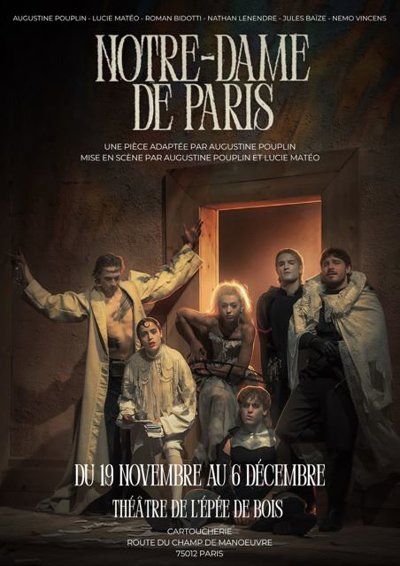
Notre-Dame de Paris
About
Automatically translated. Read the original French text.
This adaptation of Notre-Dame de Paris takes place in a world without a specific era, yet one that everyone recognizes. The cathedral is no longer a frozen monument; it becomes a body of metal, a vertical bastion, a theater of stone where all that is irrecoverable in humanity crashes down: misery, loneliness, desire, power.
There is no historical reenactment here. No folklore, no lace, no "romantic Gypsy". Only men and women cast into a society that consumes them. Esmeralda is not a muse. She is a survivor. Quasimodo is not a pure soul. He is a silence. Frollo is not a monster. He is a broken man. Phoebus is not a hero. He is a void. Clopin is not a king. He is a pauper.
Each character fights to exist in a world where beauty, morality, and justice are mere masks. The play focuses on six main figures (Esmeralda, Frollo, Phoebus, Quasimodo, Clopin, Gringoire), stripped to the bone, and traces their inexorable fall.
Love becomes a punishment. Religion, a repressed impulse. Justice, a theater of execution. The text draws upon Hugo's breath, his rage, his visions, his violence, but is entirely rewritten. It is a lyrical and brutal language, permeated by metaphors and stifling silences. The style draws inspiration from contemporary European theater: abrupt shifts in tone, surges of realism, direct addresses to the audience, embodied silences, violent soundscapes or lighting, in the tradition of Ostermeier-style theater. At the heart of the show, desire is political.
Loving, here, means putting one's body on the line in a society that ignores the poor, disdains women, and ridicules deviants. What we see is not an eroticized Esmeralda, but a young beggar, guilty of having danced, abandoned to the whims of a priest in crisis, a glacial soldier, and a blind public. The cathedral then becomes the setting of a pagan sacrifice, where beauty is hanged and silence tolls the end.
For an audience attuned to contemporary theater, for those who love classics radically reimagined, for lovers of text, and for those who have never seen Quasimodo other than in an animated cartoon.
Practical info
Last date: 6 December 2026
Full venue programme →
All dates 15
- Thursday, 19 November 2026 · 19:00 This date
- Friday, 20 November 2026 · 19:00
- Saturday, 21 November 2026 · 14:30
- Saturday, 21 November 2026 · 19:00
- Sunday, 22 November 2026 · 14:30
- Thursday, 26 November 2026 · 19:00
- Friday, 27 November 2026 · 19:00
- Saturday, 28 November 2026 · 14:30
- Saturday, 28 November 2026 · 19:00
- Sunday, 29 November 2026 · 14:30
- Thursday, 3 December 2026 · 19:00
- Friday, 4 December 2026 · 19:00
- Saturday, 5 December 2026 · 14:30
- Saturday, 5 December 2026 · 19:00
- Sunday, 6 December 2026 · 14:30