 Exhibition
Paris à l’arraché. Jacques Villeglé et l’art urbain
About
Automatically translated. Read the original French text.
What is it about?
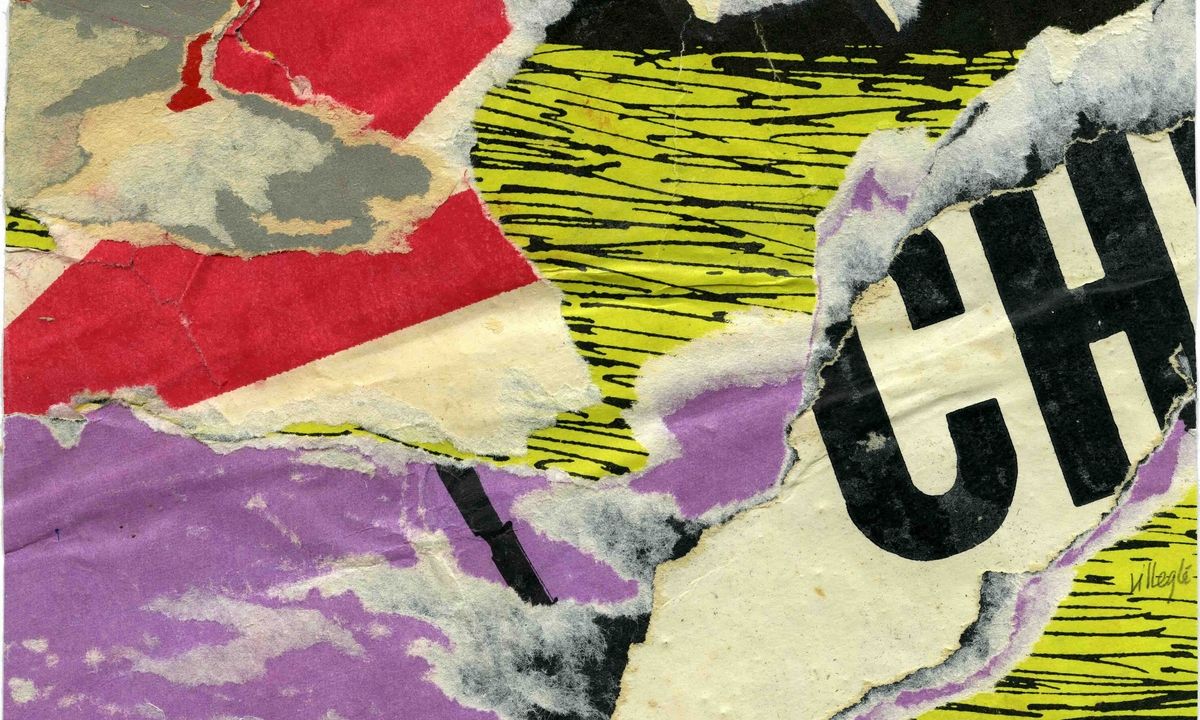
A major artist on the French scene, Jacques Villeglé developed a singular approach: he collected pieces of posters from urban spaces. His prolific body of work invites viewers to discover the history of the city through torn posters or graphic signs that he recomposed. It also allows visitors to explore his links with the multiple expressions of contemporary urban art.
An exhibition that places his works side by side with photographs, sound archives, music, film excerpts, interviews and even eyewitness accounts from the period.
Jacques Villeglé, Rue de l’Échaudé, May 31, 1961. Torn posters mounted on canvas Paris, Fonds de dotation Villeglé. ; Credits: © Fonds de dotation Villeglé / Adagp, Paris, 2026 / Photo: Fabienne Villeglé
Harry Shunk and János Kender, Jacques Villeglé, Montparnasse, Paris, February 14, 1961, photograph. Collection du Centre Pompidou-MNAM / CCI-Bibliothèque Kandinsky. ; Credits: © Centre Pompidou, MNAM-CCI Bibliothèque Kandinsky, Dist. GrandPalaisRmn / Fonds Shunk and Kender / Adagp, Paris, 2026
Jacques Villeglé, Boulevard de Belleville, May 10, 1995. Torn posters mounted on canvas Paris, Fonds de dotation Villeglé. ; Credits: © Fonds de dotation Villeglé / Adagp, Paris, 2026 / Photo: François Poivret
Jacques Villeglé, Rue de Rennes, April 1987. ; Credits: Courtesy Galerie GP & N Vallois, Paris
Editorial review
Pushing open the doors of Musée Carnavalet (Paris Centre), one steps into a fragmented, torn, collected Paris. Arriving in the capital in 1950, Jacques Villeglé turned the city into a true open-air workshop. His obsession? The posters plastered on walls, whose layers he stripped away. As a tireless stroller, he collected flashes of color, graphic signs and stickers during his walks. "His work is to allow the poetry and hidden beauties in these layers of paper torn by anonymous passers-by to emerge from urban chaos," explains Jennifer Heim, co-curator of the exhibition. But the artist also acted as a "surveyor historian": behind every retrieved piece of poster, an entire era with its share of demands, issues and upheavals unfolds.
The poster artist
Designed as a walk through Paris in the footsteps of Jacques Villeglé, the exhibition route opens with an XXL panorama of colorful posters that contrast with a gray backdrop, a nod to the facades of a Paris still darkened before the restoration work began in 1959. Here, visitors admire photographs and autochromes bearing witness to the importance of poster culture in the capital, where layers of paper could even reach several centimeters in thickness. A favorite medium for the French visual artist, who embraced it until the 1980-1990 years, before the fight against illegal flyposting eventually smothered this Parisian tradition.
The neighborhood captor
"The life of an artist must begin with strolling": it is with this quote from Jacques Villeglé that visitors enter a reconstructed library, a place he frequented often and where he theorized his practice, in particular his taste for Parisian strolling. From his writings emerge five Parisian districts where he collected posters in particular. The exhibition design takes us from Porte Maillot (17th) to Montparnasse (14th), passing through Saint-Germain-des-Prés (6th), the Marais (Paris Centre) and Les Halles (Paris Centre), like a walk following in the footsteps of his urban explorations.
The surveyor historian
May 68, independence wars in Indochina and Algeria, establishment of the Fifth Republic, struggles of postal workers: the art of Jacques Villeglé reflects the aesthetic, political and social transformations of his era. According to him, "revolutions are talkative, and those that took place in Paris knew better than any other how to make the walls speak." From these urban imprints, he even composed a sociopolitical alphabet blending the symbols of struggles clashing on the walls of Paris.
The urban art pioneer
Naturally, it is difficult not to think of subsequent generations who also made the walls speak through graffiti, tags, urban murals, stickers or collages. While he himself nuanced his status as a pioneer of urban art, his work nonetheless nourished exchanges with numerous street artists, as the final section of the exhibition highlights. In a video recording captured during a performance at the Palais de Tokyo (16th) in 2013, he can notably be seen adding the finishing touch to a collective artwork created by some twenty artists, including the duo Lek & Sowa.
Leaving Musée Carnavalet, one finds oneself looking at city walls differently: as catalysts of collective anger and talkative witnesses to a shared Parisian history.
Eva Y.
Practical info
Full venue programme →