Photographier l'action : mémoire visuelle, performance et mise en scène de 1970 à nos jours - Galerie Dominique Fiat
Galerie Dominique Fiat — 12 rue Martel, 75010 Paris
- AccessibilityHearing impairment
About
Automatically translated. Read the original French text.
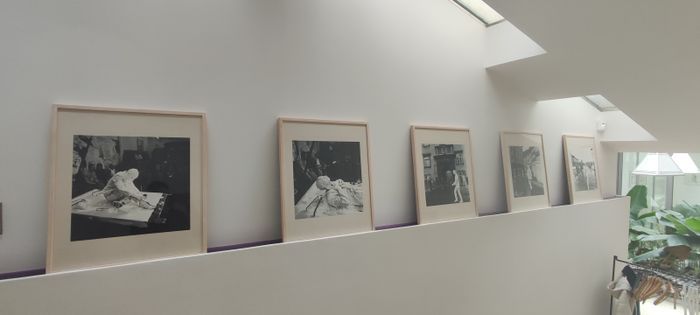
From the streets of Vienna in 1970 to contemporary rituals in Benin, this exhibition explores how photography does not merely document performance, but becomes its space, its trace, and sometimes its very extension.
Through works by Günter Brus, Nicola Lo Calzo, Hannah Collins, John Goto, Chantal Regnault, Emo de Medeiros, and Sue Williamson, the exhibition demonstrates how, for over fifty years, the photographic image has accompanied, constructed, and prolonged performative, political, ritual, and cultural gestures.
In 1970, during Wiener Spaziergang, Günter Brus walked through Vienna with his body painted in Austrian colors. The action was ephemeral, scandalous, almost elusive. Photographs ensured its posterity, transforming a performative act into an icon of Viennese Actionism.
With the KAM project, Nicola Lo Calzo explores memories of slave resistance through contemporary stagings. Here, photography does not record an event: it produces the action; it is the theater where invisibilized histories are reenacted.
In Routes to Ferran Adrià, Hannah Collins stages the human, geographical, and economic networks connecting food to its origins. The performance becomes diffuse, inscribed in daily movements and gestures that the image makes visible.
The photographic tableaux of High Summer by John Goto reenact social and political scenes with near-pictorial precision. Staging becomes a critical tool, where photography constructs a performance designed for the image.
In 1990, Chantal Regnault photographed voguing balls in New York. She captured a performative culture born in the margins, where identity is constructed in the instant of the runway. Today, her images are essential archives of a scene whose transmission photography ensured.
In Benin, Emo de Medeiros documents voodoo ceremonies where ritual performance, ancestral memory, and contemporaneity intersect. The image becomes a mediation between the visible and the invisible.
With All Our Mothers, Sue Williamson stages the memory of South African women who resisted apartheid. Photography becomes a space of symbolic reparation, where the performance of memory is reenacted before the camera.
A broader history of performance through photography
The exhibition shows that, from 1970 to the present day, photography has moved from being a document of action to a tool of staging, and then to the very space in which performance exists.
It reveals how a still image can hold movement, politics, ritual, and intimacy, and how performance finds in photography an active memory rather than a simple recording.
This exhibition is part of the Photography in Art Galleries circuit, organized by the Comité Professionnel des Galeries d'Art.
Where to book
Getting there
DirectionsGalerie Dominique Fiat
12 rue Martel, 75010 Paris, Paris
- M4Château d'Eau / Mairie du 10e5 min walk
- M4M5M7P+1Gare de l'Est7 min walk
Stations: Île-de-France Mobilités
Full venue programme →Sources : OpenAgenda · details last read on 14 November 2026